


Author: Kathiann Kowalski / Source: Science News for Students
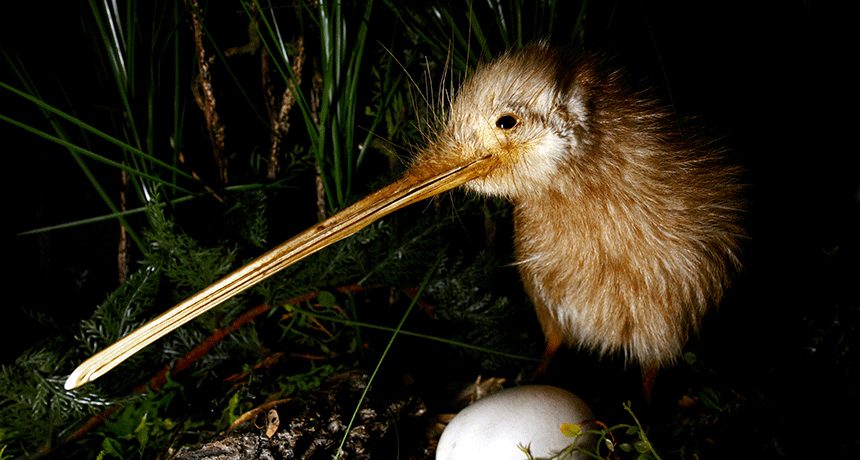
Kiwis and other native birds in New Zealand are in trouble.
In the 19th century, European traders and immigrants introduced many foreign rats, stoats and other animals to the South Pacific island nation. Since then, many of these non-native animals — known as invasive species — have been preying on the native birds, some of which don’t fly. New Zealand’s leaders want to get rid of the invaders. And a new technology could help. But scientists are now questioning whether that is a smart thing to do.Kevin Esvelt is an evolutionary ecologist at the Massachusetts Institute of Technology in Cambridge. An evolutionary ecologist studies the genetics of living things and how species have changed over time. “You need to be very careful,” Esvelt says. It’s always possible, he notes, that some “solution” might cause problems elsewhere in an ecosystem.
Esvelt is talking with people in New Zealand about a plan. They’re considering use of a type of gene-editing tool known as a gene drive. It can copy and paste itself into the genome of an organism. (A genome is the complete set of genetic instructions in an organism.) Once the gene drive is inside the genome, it could change the genes of some invasive species in a way that would make that species die off at sites where it doesn’t belong.
That may sound like a good thing. Indeed, many scientists hope it will be. Still, they have concerns. After all, if a gene drive “escapes,” it could kill that targeted species even in places where it does belong.
Tina Saey of Science News magazine has a doctorate degree in molecular genetics. She has covered gene editing and gene drives a lot. In an award-winning feature story in the magazine, she notes: “Researchers have designed ways to keep [gene drives] confined in the lab.” However, she adds, “no such safety nets exist for gene drives released into the wild.”
Wiping out an entire species, even if it’s a pest, raises questions about whether such a move would be the right thing to do. To date, she points out, scientists and policymakers are only just starting to think about this.
How it works
In recent years, a new and very popular tool has been available to tinker with genes. It’s known as CRISPR/Cas9. Most people just call it CRISPR. (That’s much shorter than using its entire name: “clustered regularly interspaced short palindromic repeats.”) The Cas9 part is an enzyme. It’s a molecular scissors, of sorts, that cuts DNA.
Scientists inject Cas9 into a cell in which they want to alter DNA. But Cas9 is blind and doesn’t know where to make cuts. It needs a buddy, like a guide dog, to show it where to snip. In this case, the guide dog is a small piece of another type of genetic material, called RNA. The guide RNA shows Cas9 where to cut.
Guide RNAs are very picky. They will only take Cas9 to one particular place in the genome. It’s similar to a guide dog leading its owner to one particular subway station and to the correct track. Even though there are many subway stations and multiple tracks, only one is the right one.
Once Cas9 and its guide reach their destination, the scissors snips the DNA. Then, other things can happen. One possibility is that the cell can repair the cut. Sometimes the repair is done by sticking the cut ends back together. That can break the gene. Sometimes the repair fixes a previously broken gene, by using a healthy copy of the gene as a pattern. Scientists have used this RNA-enzyme combo to break and fix genes in many types of animals.
Another possibility is that a piece of DNA that the researchers have injected into the cell (along with Cas9) can be pasted into the…
The post Can DNA editing save endangered species? appeared first on FeedBox.