


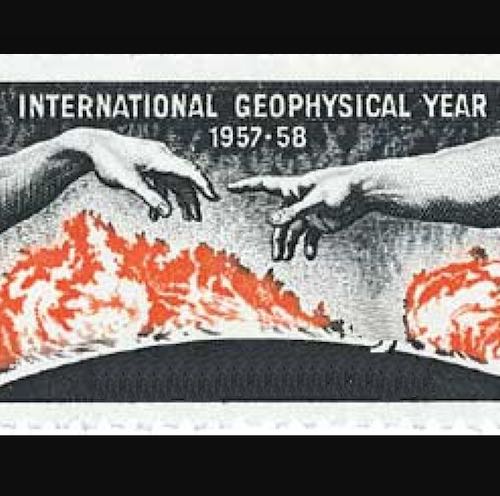
60 years ago today, the International Geophysical Year was launched by 67 countries to cooperate in the scientific study of the Earth. A global project that became a resounding success, it marked the end of a long Cold War period devoid of scientific interchange between East and West.
The IGY encompassed eleven Earth sciences, including meteorology, oceanography, seismology, geomagnetism, gravity, ionospheric physics, precision mapping, and solar activity. The timing of IGY was particularly beneficial since it covered the high point of the eleven-year cycle of sunspot activity. Significant achievements included… (1957)Both the Soviet Union and the U.S. launched artificial satellites, including the Soviet Union’s Sputnik 1, the first ever to be successful. Also notable were the discovery of the Van Allen radiation belts by Explorer 1, the defining of mid-ocean submarine ridges, which confirmed plate tectonics, and the detection of hard solar corpuscular radiation that could be highly dangerous for manned space flight.
How did the IGY come about? On April 5, 1950, a small group of scientists gathered to meet with a visiting scientist from England. The men, all geophysicists, discussed the complexity of Earth’s oceans, atmosphere, magnetism, and the role of the sun. They agreed that with all the new tools available, such as rockets, radar, and computers, perhaps it was time for a coordinated, worldwide study of Earth’s systems. Two years later, the International Council of Scientific Unions proposed a comprehensive series…
The post Good News in History, July 1 appeared first on FeedBox.