


Author: Bruce Bower / Source: Science News
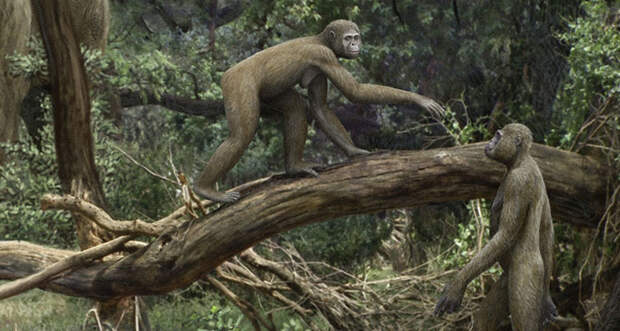
A famous 4.4-million-year-old member of the human evolutionary family was hip enough to evolve an upright gait without losing any tree-climbing prowess.
The pelvis from a partial Ardipithecus ramidus skeleton nicknamed Ardi (SN: 1/16/10, p. 22) bears evidence of an efficient, humanlike walk combined with plenty of hip power for apelike climbing, says a team led by biological anthropologists Elaine Kozma and Herman Pontzer of City University of New York. Although researchers have often assumed that the evolution of walking in hominids required at least a partial sacrifice of climbing abilities, Ardi avoided that trade-off, the scientists report the week of April 2 in the Proceedings of the National Academy of Sciences.
“Ardi evolved a solution to an upright stance, with powerful hips for climbing that could fully extend while walking, that we don’t see in apes or humans today,” says Pontzer, who is also affiliated with CUNY’s Hunter College. Ardi’s hip arrangement doesn’t appear in two later fossil hominids, including the famous partial skeleton known as Lucy, a 3.2-million-year-old Australopithecus afarensis.
Ardi’s lower pelvis is longer than that of humans, which led some researchers to argue that Ardipithecus mainly climbed in trees and walked slowly with bent knees and hips, or perhaps not at all.
But the new study shows it “would not have impeded its ability to walk upright in a humanlike fashion,” says paleoanthropologist Carol Ward of the University of Missouri in Columbia.A digital reconstruction of 4.4-million-year-old Ardi’s pelvis, in gray, fits inside 3.2-million-year-old…
The post Ardi walked the walk 4.4 million years ago appeared first on FeedBox.