


Author: Sarah Laskow / Source: Atlas Obscura
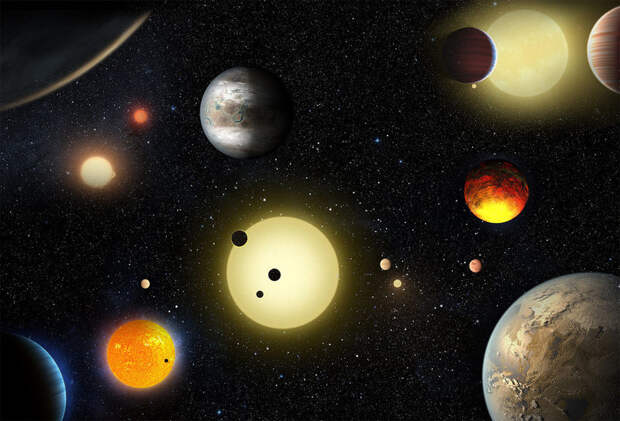
One of the greatest challenges that civilizations face is communicating across vast distances. Over the millennia humans have gotten much better (and faster) at it: signal fires, resonant drums, and fleet-footed messengers gave way to telegraphs, then radios and telephones, and now satellite phones and the internet.
Those systems all work well, to some extent, here on Earth. But when we look outward into the universe and imagine a conversation with some other form of intelligent life, we’re faced with radically larger distances, which take mind-bending amounts of time to cross.How would a system of communication with extraterrestrial intelligence work? In a new paper, published in the International Journal of Astrobiology, Duncan Forgan, an astrophysicist at the University of St. Andrews, proposes an interstellar communication network that would work like a planetary equivalent of smoke signals. It starts with planets passing in front of the stars they orbit.
Over the past decade, since the Kepler space observatory launched in 2009, scientists have identified more than 2,500 exoplanets orbiting distant stars (along with thousands of possibilities for more). By studying how light from their stars passes around the planets and through their atmospheres, known as a transit signal, scientists have been able to understand the sizes and characteristics of these planets—some of which could support life as we know it. These observations could one day hint at the presence of biological life on an exoplanet: Living things—even if they’re not intelligent— change the chemical signature of a planet’s atmosphere.
“When it comes to looking for something that’s intelligent, you want something a bit more brash,” says Forgan. An extraterrestrial intelligence, he posits, might deliberately modify a planet’s transit signal with a laser or by building a giant orbiting object. Either strategy would make the signal look weird enough that…
The post How to Create an Interstellar Network of Planets appeared first on FeedBox.