


Author: Tina Hesman Saey / Source: Science News for Students
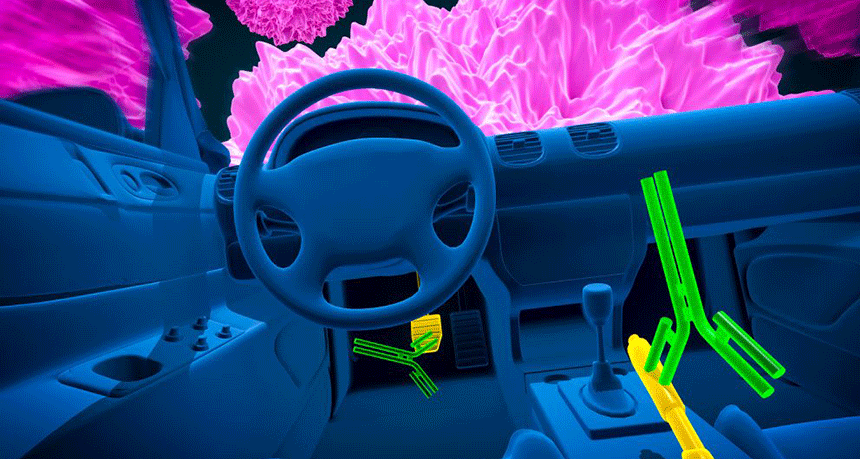
Rev up that immune system! Using the metaphor of a car, the green structures here illustrate how antibodies can take the brake off of the body’s immune system. This lets the body naturally attack cancer cells.
The discoveries that make this therapy possible are behind the 2018 Nobel Prize for physiology or medicine.Doctors used to target cancers only with scalpels, toxic chemicals and radiation. Recently, a new therapy has been emerging. It instead allows the body’s immune system to take out cancer cells. Two men who did the pivotal work that made such an immune therapy for cancer possible were today awarded the Nobel Prize in physiology or medicine.
James P. Allison, 70, works at the MD Anderson Cancer Center in Houston, Texas. He will share this year’s award with Tasuku Honjo, 76, of Kyoto University in Japan. At a ceremony in December, the two will equally share the prize of 9 million kronor. That’s equal to a little more than $1 million.
Discoveries by these men “have added a new pillar in cancer therapy,” says Klas Kärre. This immunologist works at the Karolinska Institute in Stockholm, Sweden. He also is a member of the Nobel committee that awarded today’s prize. Immune therapy against cancer is “a new principle,” he observes. Other therapies — such as surgery, radiation and chemotherapy — targeted tumor cells. The new strategy instead revs up a patient’s own immune system. It gives cellular players in that immune system permission to attack the cancer.
The basic discoveries by Allison and Honjo represent a new “landmark in the fight against cancer,” Kärre said as he announced today’s award.
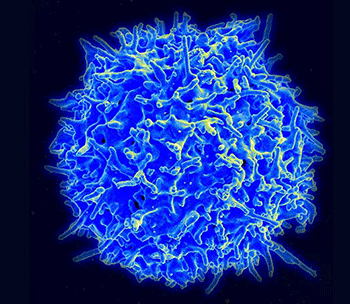
CTLA-4 is the name of a protein on the surface of immune cells, known as T cells. Allison discovered that this protein holds T cells back from attacking cancer cells. You might think of it as acting like the brake on a car. Allison’s lab worked to release that brake. To do it, they developed an antibody against the protein. And that, his team showed, allows T cells to kill tumor cells.
In a series of experiments, Allison and his colleagues used this immune therapy in mice with cancer. The treatment actually cured the rodents or shrank their tumors.
The technique has worked especially well against a type of human skin cancer known as melanoma. In 2011, the U.S. Food and Drug Administration, or FDA, approved a drug to treat that type of cancer. Known as ipilimumab (Ih-pih-LIH-myoo-mab), it is sold under the brand name Yervoy. More recently, it also has been approved to treat…
The post Immune targeting of cancers wins two a 2018 Nobel Prize appeared first on FeedBox.