


Author: Helen Thompson / Source: Science News
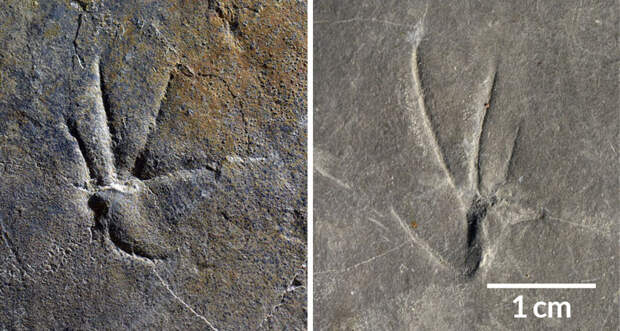
Fossilized footprints from an iguana-like reptile provide what could be the earliest evidence of a lizard running on two legs.
The 29 exceptionally well-preserved lizard tracks, found in a slab of rock from an abandoned quarry in Hadong County, South Korea, include back feet with curved digits and front feet with a slightly longer third digit. The back footprints outnumber the front ones, and digit impressions are more pronounced than those of the balls of the feet. The lizard’s stride length also increases across the slab.
That’s what you’d expect to see in a transition from moseying along on four legs to scampering on two, says Yuong-Nam Lee, a paleontologist at Seoul National University who first came across the slab back in 2004. A closer examination two years ago revealed the telltale tracks.
Lee and his colleagues attribute the tracks to a previously unknown lizard ichnospecies, that is a species defined solely by trace evidence of its existence, rather than bones or tissue. Lee and his colleagues have dubbed the possible perpetrator Sauripes hadongensis and linked…
The post Fossil footprints may put lizards on two feet 110 million years ago appeared first on FeedBox.