


Author: Evan Nicole Brown / Source: Atlas Obscura

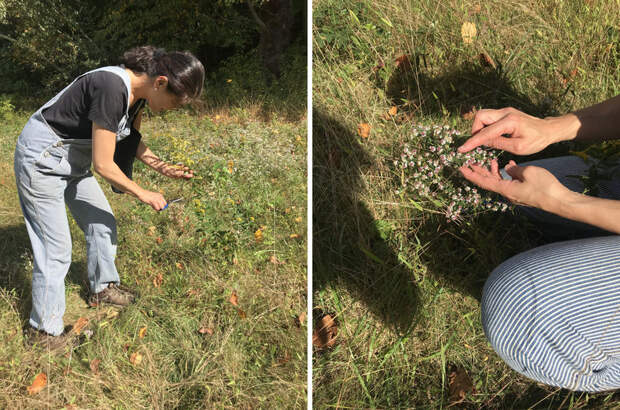
It’s the patch of goldenrod that pulls us to the ground first. “I want to collect some of this,” Kazumi Tanaka says, crafting scissors in hand.
Tanaka is gathering richly colored flora native to Manitoga, a 75-acre woodland estate in Garrison, New York, for her most recent artistic pursuit: creating natural watercolor inks from plant specimens. Tanaka is Manitoga’s fifth and current artist-in-residence, and her project INK: The Color of Manitoga illustrates the scientific process behind her art making. Once the natural materials are chemically transformed into watercolors, the multidisciplinary artist paints botanical drawings with the ink derived from the plant specimens.
The artist residency at Manitoga is a year long, so Tanaka began her search for naturally occuring hues in January 2018. “I came across the mountain laurel because it was red and green which I didn’t expect to see in the middle of winter,” Tanaka says. “And I managed to make three different colors out of that specimen.” Using a lab set-up she built herself (Tanaka is also a woodworker and antique furniture restorer), she crushes the specimens she’s collected until leaves become liquid, and petals become pigment. Left with a concentrated amount of vivid plant paste, Tanaka uses a high-school chemistry set to distill water from Manitoga’s Quarry Pool and mixes it in with the “paint,” along with gum arabic for preservation purposes.
There are other bodies of water on the estate that Tanaka considered drawing water out of, like the silent and reflective “Lost Pond.” But based on her observations, the pond’s water had too much algae in it to be usable because, as Tanaka says, “it’s a still water, whereas the Quarry Pool is constantly moving.”Following a half-hour process of letting all the ingredients settle, a natural ink emerges like a new crop bursting from the soil. The final step in this plant-to-paint transformation happens now. “As long as I transfer [the ink] to the paper right away, it remains quite a fresh color,” Tanaka says. Once the inks are ready for use, the artist creates a series of botanical drawings and paints each one with ink derived from the plant depicted. Think of a sustainable version of color-by-number, except Tanaka colors by species.

Tanaka’s environmentally conscious art is rooted in her upbringing and culture. “I was thinking about how my parents used to go fishing and they used to just eat what they caught,” she says. “And how they used to say ‘it just tastes different.’ It’s a similar concept.” Though Tanaka celebrates the wide color spectrum of manufactured watercolor paints available in art stores, her interest in making her own comes from an innate curiosity about the world. “[I love] giving a challenge to myself and thinking, ‘What can I create?’ Everything in this room I made from out there!” she says, gesturing toward the wall-sized window that encloses her lab. “It just makes it worthwhile to do this effort.”
The grounds of Manitoga began as a rock quarry, purchased in 1942 by American industrial designer…
The post How One Woman Transforms Plants Into Pigment appeared first on FeedBox.