


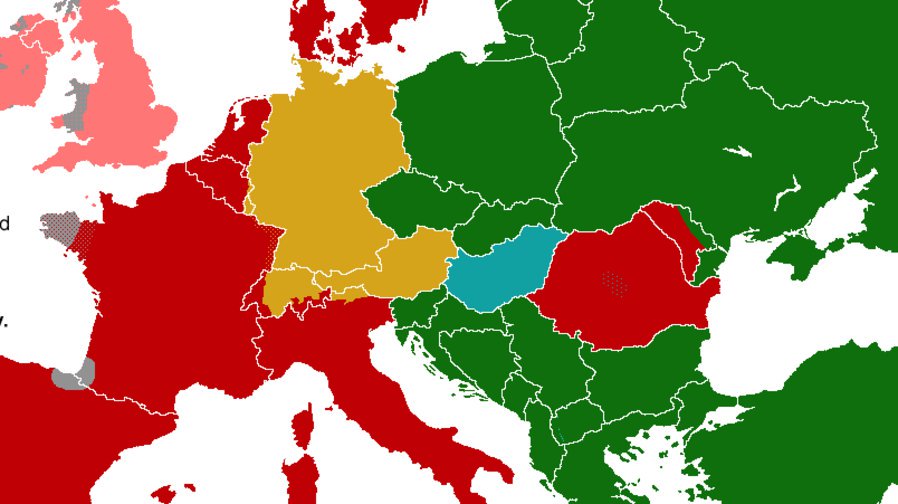
For English-speakers, Romanian is easier to learn than German. And you’ll be speaking Russian sooner than Hungarian.
How is that? Because the Foreign Service Institute says so. Located in Arlington, Virginia, the FSI is the U.S. government’s main provider of foreign affairs training, including language courses.
As the chief learning organisation for the State Department, the FSI is where diplomats go to study the languages they will need on foreign postings. The Institute has a very practical approach to languages, dividing them into five categories, depending solely on how long it takes to learn them.
This map shows how the FSI judges the difficulty of European languages. Note that the Institute only teaches languages that are required for diplomatic intercourse; hence the grey spots on the map.
You won’t find any courses in Basque (the area straddling the Franco-Spanish border), Breton (in the ‘nose’ of France), Welsh (in, ehm, Wales) or Scots or Irish Gaelic in Arlington. In the countries where those minority languages are spoken, you’ll get by with Spanish, French and English.
English, by the way, is a ‘Category 0’ language (pink on the map), meaning that Americans are expected to be proficient in it. English is of course an official language in Ireland and the UK, but also in Malta (although it is coloured grey on the map, since it also has its native Maltese language, which is based on Sicilian Arabic and is the only Semitic language to have official status in the European Union).
‘Category I’ languages (in red on the map) are the easiest for English speakers, who should be able to reach reading an speaking proficiency within approximately 24 weeks (i.
e. a little less than half a year of intense study).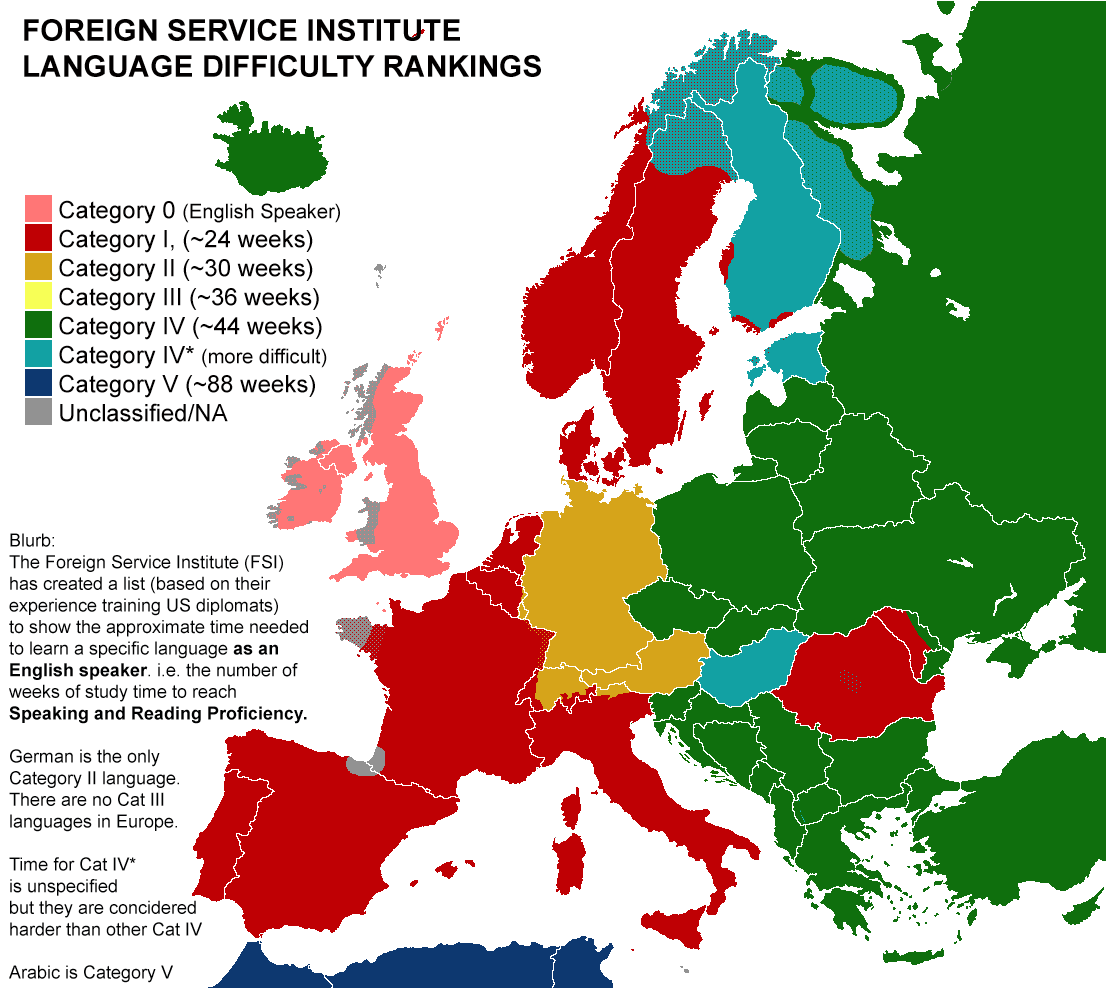
These languages include both Germanic ones (Dutch, Danish, Norwegian and Swedish) and Romance ones (French, Spanish, Portuguese, Italian, Romanian). That may seem strange, since English is more closely related to the former than the latter.
However, the peculiar history of English means that it is heavily influenced by French (and Latin), especially in vocabulary. One study says that the share of Latin and French words in English is greater than that of Germanic origin (29% each, versus 26%).
German, on the other hand, might share a lot of basic vocab with English (1), but according to the FSI it is a ‘Category II’ language (orange) – meaning that it would require around 30 weeks of intense study to master written and spoken proficiency.
That doesn’t quite chime with the experience of Mark Twain, who wrote that
“(m)y philological studies have satisfied me that a gifted person ought to learn English (barring spelling and pronouncing) in thirty hours, French in thirty days, and German in thirty years. It seems manifest, then, that the latter tongue ought to be trimmed down and repaired. If it is to remain as it is, it ought to be gently and reverently set aside among the dead languages, for only the dead have time to learn it” (2).
So why is German rated a grade more difficult than, Dutch, which is a directly related language, or even than Romanian, which is from another language family altogether?
Because, despite the large extent to…
The post How Long to Learn That Language? Here’s a Map for That appeared first on FeedBox.