


Source: Farnam Street
We are not taught how to learn in school, we are taught how to pass tests. The spacing effect is a far more effective way to learn and retain information that works with our brain instead of against it. Find out how to use it here.
“Every perception is to some degree an act of creation, and every act of memory is to some degree an act of imagination. ”
— Gerald Edelman, Second Nature: Brain Science and Human Knowledge
The most important metaskill you can learn is how to learn. Learning allows you to adapt. As Darwin hinted, it’s not the strongest who survives. It’s the one who easily adapts to a changing environment. Learning how to learn is a part of a “work smarter, not harder” approach to life—one that probabilistically helps you avoid becoming irrelevant. Your time is precious, and you don’t want to waste it on something which will just be forgotten.
During the school years, most of us got used to spending hours at a time memorizing facts, equations, the names of the elements, French verbs, dates of key historical events. We found ourselves frantically cramming the night before a test. We probably read through our notes over and over, a gallon of coffee in hand, in the hope that the information would somehow lodge in our brains. Once the test was over, we doubtless forgot everything straight away.1
Even outside of formal education, we have to learn large amounts of new information on a regular basis: foreign languages, technical terms, sale scripts, speeches, the names of coworkers. Learning through rote memorization is tedious and—more important—ineffective.
If we want to remember something, we need to work with our brains, not against them. To do that, we need to understand cognitive constraints and find intelligent ways to get around them or use them to our advantage.This is where the spacing effect comes in. It’s a wildly useful phenomenon: we are better able to recall information and concepts if we learn them in multiple, spread-out sessions. We can leverage this effect by using spaced repetition to slowly learn almost anything.
It works for words, numbers, images, and skills. It works for anyone of any age, from babies to elderly people. It works for animals, even species as simple as sea slugs. The effect cuts across disciplines and can be used to learn anything from artistic styles to mathematical equations.
Spaced repetition might not have the immediacy of cramming or the adrenaline rush of a manic all-nighter. But the information we learn from it can last a lifetime and tends to be effectively retained. In some ways, the spacing effect is a cognitive limitation, yet a useful one—if we are aware of it.
In Fluent Forever: How to Learn Any Language and Never Forget It, Gabriel Wyner writes:
Spaced repetition…[is] extraordinarily efficient. In a four-month period, practising for 30 minutes a day, you can expect to learn and retain 3600 flashcards with 90 to 95 percent accuracy. These flashcards can teach you an alphabet, vocabulary, grammar, and even pronunciation. And they can do it without becoming tedious because they’re always challenging enough to remain interesting and fun.
In Mindhacker, Ron and Marty Hale-Evans explore further:
Our memory is simultaneously magnificent and pathetic. It is capable of incredible feats, yet it never works quite like we wish it would. Ideally, we would be able to remember everything instantly, but we are not computers. We hack our memory with tools like memory palaces, but such techniques required effort and dedication. Most of us give up, and outsource our memory to smartphones, cloud enabled computers, or plain old pen and paper. There is a compromise…a learning technique called spaced repetition which efficiently organizes information or memorization and retention can be used to achieve near perfect recall.
“If you wish to forget anything on the spot, make a note that this thing is to be remembered.”
The Discovery of The Spacing Effect
Hermann Ebbinghaus (1850-1909), a German psychologist and pioneer of quantitative memory research, first identified the spacing effect. After earning his PhD in Germany, he traveled to London. Like so many people, he found his life forever changed by a book.
The work in question was Elements of Psychophysics by the pioneering experimental psychologist Gustav Fechner. Inspired by this book, Ebbinghaus began the research into memory that would consume his career and impact all of us.
Ebbinghaus took up his new field of study with the unbridled zest of a newcomer. He didn’t believe strongly in the prevailing understanding of memory at the time. In his wish to avoid getting bogged down in theory, he made everything about experimentation. As researcher and the sole subject of his experiments, he faced an uphill battle.
His most important findings were in the areas of forgetting and learning curves. These are graphical representations of the process of learning and forgetting. The forgetting curve shows how a memory of new information decays in the brain,2 with the fastest drop occurring after 20 minutes and the curve leveling off after a day.
There is a way to slow down the process of forgetting. We need only to recall or revisit the information after we originally come across it. Going over the information later, at intervals, helps us remember a greater percentage of the material. Persistence will allow us to recall with 100% accuracy all that we want to remember.
The learning curve is the inverse. It illustrates the rate at which we learn new information.
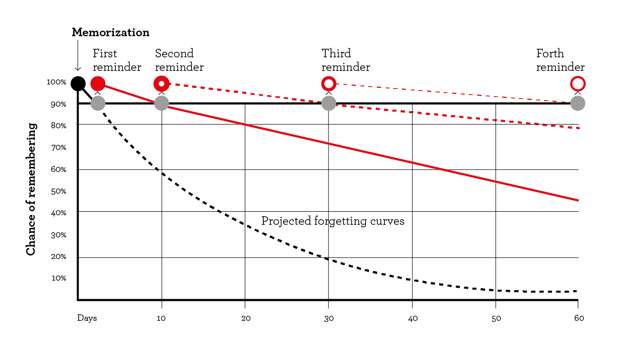
When we use spaced repetition, the forgetting curve changes:
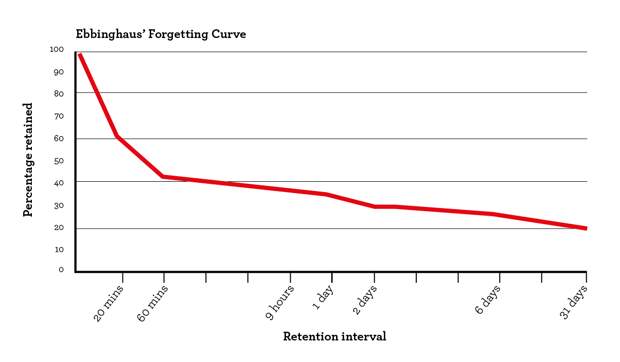
Frequency matters. Under normal conditions, frequent repetitions aid memory. We know this intuitively. Just try to memorize this article on a single repetition. However much attention, focus, or individual ability you have, it won’t work.
Memory mastery comes from repeated exposure to the material. Ebbinghaus observes, “Left to itself every mental content gradually loses its capacity for being revived, or at least suffers loss in this regard under the influence of time.” Cramming is not an effective memorization strategy. Lacking the robustness developed in later sessions, crammed facts soon vanish. Even something as important and frequently used as language can decay if not put into use.
There are other ways to improve memory. Intensity of emotion matters, as does the intensity of attention. Ebbinghaus notes in his definitive work on the subject, Memory and Forgetting:
Very great is the dependence of retention and reproduction upon the intensity of the attention and interest which were attached to the mental states the first time they were present. The burnt child shuns the fire, and the dog which has been beaten runs from the whip, after a single vivid experience. People in whom we are interested we may see daily and yet not be able to recall the colour of their hair or of their eyes…Our information comes almost exclusively from the observation of extreme and especially striking cases.
Ebbinghaus also uncovered something extraordinary: even when we appear to have forgotten information,…
The post The Spacing Effect: How to Improve Learning and Maximize Retention appeared first on FeedBox.